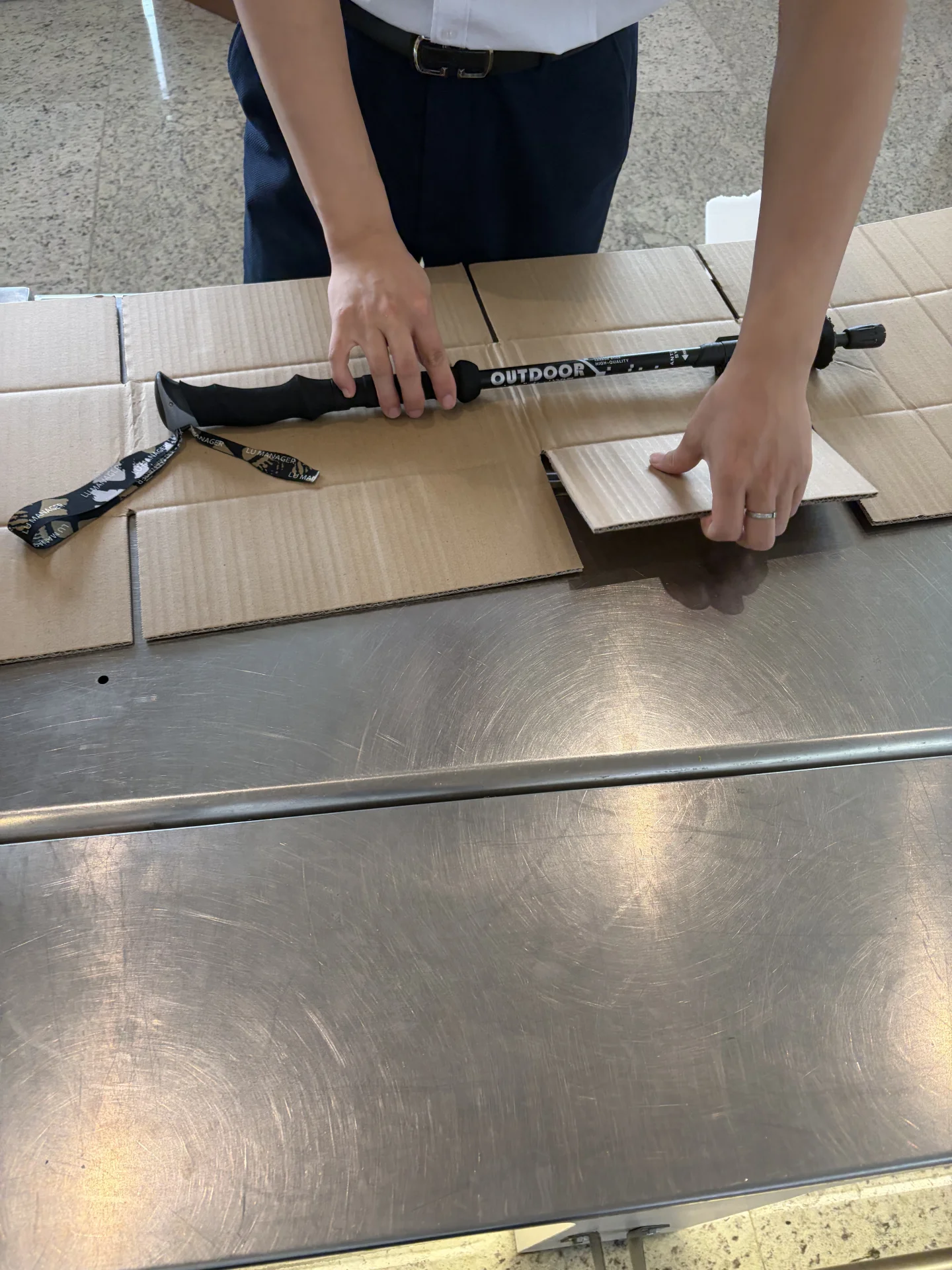
Blunt-tipped hiking poles are allowed in carry-on and checked bags under the TSA’s current guidance; sharp-tipped hiking poles are not allowed in carry-on bags. TSA officers make the final checkpoint decision, and your airline must also allow the item in the cabin. Check the actual tips, the airline’s policy, and the packed length before choosing how to travel.
Start with the tip, then the baggage rules
The TSA’s hiking-pole entry, checked November 9, 2026, distinguishes blunt tips from sharp tips. Its carry-on permission is conditional on that distinction. Folding a pole shorter changes its size, but does not change what the tip is.
Look at the poles you intend to pack, including any removable rubber feet and the metal points beneath them. A protective cap is useful for packing; the TSA entry does not say that covering a sharp point with a removable cap guarantees carry-on approval. If the classification of your particular setup is unclear, ask TSA before travel and plan an alternative.
Next, ask the operating airline whether it allows those poles in the cabin. Give the airline the tip description and the folded measurements. Check whether the poles must fit fully inside your allowed bag and whether a separate case counts toward your baggage allowance.
Keep the two decisions together in your travel notes. A pole that fits the bag can still be unsuitable for cabin travel, and a permitted item can still exceed the airline’s size allowance. Neither question is answered by a photograph of someone else’s luggage.
Measure the poles in the state you will pack them
Fold or collapse each pole using its intended mechanism, then measure the longest dimension including the grip and tip protector. Try the pair inside the actual bag with the rest of your luggage. Allow room for padding rather than checking fit with empty poles alone.
One traveler measured a folded pole at about 23.6 inches. That is a useful reminder that “folding” does not always mean short enough for a particular suitcase. Measure your own equipment and compare it with the space inside the bag.
Some telescoping poles remain much longer when collapsed than a corded folding design. Other folding poles have fixed-length sections that determine their minimum packed size. Check the manufacturer’s packed-length specification, then confirm it with your assembled travel setup.
Removing a section is appropriate only if the maker describes it as part of packing or disassembly. Keep internal locks and cords intact. If the pole will not fit without forcing or dismantling a mechanism, choose a larger permitted bag or another transport plan.
Choose carry-on or checked baggage deliberately
Carry-on can be practical for a blunt-tipped design when the airline agrees and the packed equipment fits. Have a plan for what you will do if the checkpoint decision differs from your expectation. That might mean returning to the airline’s check-in area while there is still time.
For sharp-tipped poles, plan checked baggage for US checkpoint travel. Confirm how the airline wants the poles packed and whether the container falls within the allowance for your ticket. Ask about the packed case rather than describing only the bare poles.
A separate narrow pole package may be handled differently from poles packed inside a suitcase. Establish the bag count and any charge directly with the airline before departure. A cardboard sleeve provides a different level of protection from a rigid case, so choose packaging for both the equipment and the planned handling.
Question before departure
What to record
Are the tips blunt or sharp?
The actual tip construction, including removable covers
Does the airline allow cabin carriage?
Its answer for your equipment and operating flight
Will the poles fit inside the bag?
Fully packed length and the space available
Is a separate container allowed?
Bag count, dimensions, and any applicable charge
What happens on the return?
The carrier and departure-country requirements to check
Protect the tips and stop the sections moving
Clean and dry the poles before packing. Fold or collapse them as designed, put tip protectors in place, and bundle the sections so they cannot swing into the bag’s contents. Keep straps tucked in rather than hanging outside the package.
A sleeve or rigid container can separate hard parts from clothing and other belongings. Pad the grips and locks where they might be pressed against another object. If the poles sit diagonally inside a suitcase, check both ends after the bag is fully packed.
Check the whole package. A packing photograph shows a pole being enclosed in a cardboard sleeve, with the grip and shaft aligned. Before closing your own container, check that the pointed ends are protected and cannot move through an opening.
A second useful check is movement: gently shift the packed bag and listen or feel for loose sections. Open it again if the bundle slides. Use internal restraint and padding instead of relying on the outer suitcase alone to hold everything still.
Keep small removable parts in a secure pouch. Make sure you can identify which tips and baskets belong to the poles when unpacking. Avoid loose pieces that could be lost during inspection or caught in a bag’s zipper.
Leave enough time to resolve a baggage question
Settle the packing plan before arriving at the checkpoint. If you intend to check the poles, keep them with the checked luggage at the start of the process. If you need airline confirmation, obtain it while you still have access to the bag and time to change the arrangement.
For a connection, identify the airline that operates each flight. A ticket sold by one carrier may include a flight operated by another. Check the applicable baggage conditions for each part of the trip rather than relying only on the name on the booking email.
Keep the checked date beside any policy notes. Policies and equipment can change between trips, so look again before reusing last year’s packing plan. A small change in pole design or the case you use can also change the dimensions.
Check the return trip separately
TSA guidance answers the US checkpoint question. For a departure elsewhere, check that country’s aviation-security authority and the operating carrier. Do this before choosing a cabin-only plan that depends on carrying the poles home.
If you want to avoid taking your own poles, consider whether you can arrange suitable equipment at the destination. Confirm availability, fit, and collection details ahead of time. Build the plan around what your hike needs, including any use of the poles for a shelter.
After the flight, inspect the poles before taking them onto a trail. Check the shafts, grips, locks, and tips, then assemble and test them on level ground. Address a damaged or missing part before relying on the equipment during the hike.
FAQ
Are hiking poles allowed in carry-on bags?
TSA currently allows blunt-tipped hiking poles in carry-on bags, subject to screening and the officer’s decision. Sharp-tipped hiking poles are not permitted in carry-on bags. Your airline must also allow cabin carriage and the packed equipment must meet its baggage conditions.
Can folding hiking poles go in carry-on luggage?
Folding addresses the size question, while the tip and airline rules still apply. Measure the complete folded bundle with its protectors and check it inside your actual bag. Ask about your particular equipment if its tip classification is unclear.
How should trekking poles be packed for checked baggage?
Protect the tips, secure the folded or collapsed sections, and pad hard parts against movement and pressure. Keep small accessories contained and confirm the airline’s requirements for the packed bag or separate case. Inspect and test the poles after travel.